Air travel
Carry-On Packing List: What to Pack in Hand Luggage
A useful carry-on checklist starts with the allowance on your actual ticket, then organizes essentials around security screening and what needs to remain accessible during the journey. There is no single carry-on size that applies to every airline.
Check the airline’s item count, dimensions and weight first. Then pack travel documents, medication, electronics, clothing and liquids according to the rules that apply to your departure points, keeping critical items easy to reach.
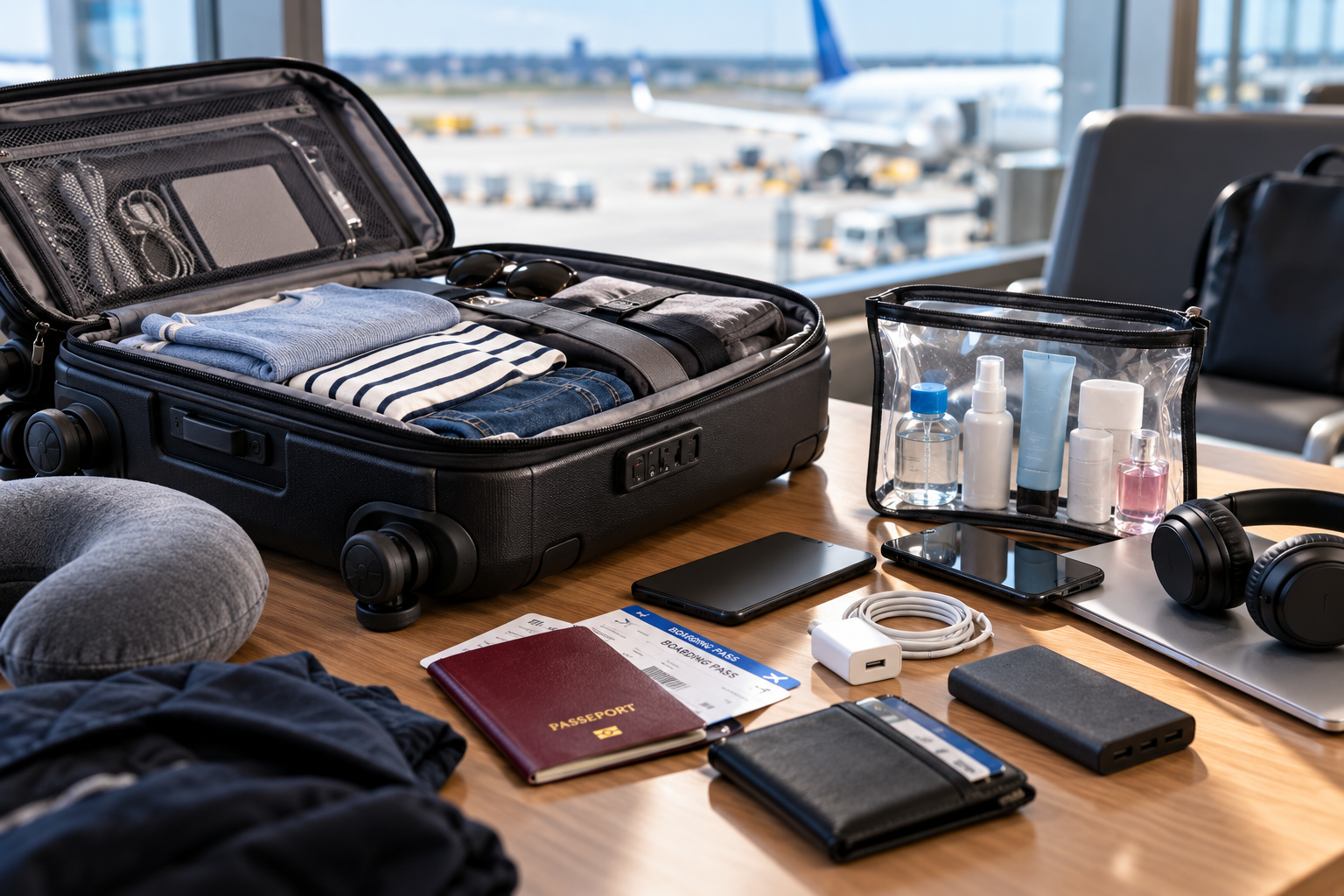
Before the checklist: verify your carry-on allowance
Start with the booking and the airline’s own baggage page. Check how many pieces are included, whether a personal item is separate from the overhead carry-on, the maximum dimensions, the weight limit and any restrictions tied to the fare you purchased.
Do not copy measurements from another airline or an older trip. Commercial baggage limits vary, and an airline may be more restrictive than the general security rules.
If the itinerary uses multiple airlines or separate tickets, verify every segment. The allowance that matters is the one that actually applies to that flight.
Carry-on packing checklist: the essentials
Documents and access
- Required passport or identification
- Boarding pass and useful booking details
- Payment methods
- Arrival address and essential trip information
- Keys and critical personal items
Electronics
- Phone and charging cable
- Laptop or tablet when needed
- Required chargers and plug adapter
- Headphones or earbuds
- Power bank only after checking the applicable battery rules
Clothing
- Outfits matched to trip length and itinerary
- Underwear and socks
- Sleepwear when needed
- A warm or rain layer
- A backup outfit when the context justifies it
Toiletries and health
- Essential medication
- Toiletries that comply with screening rules
- Glasses or contacts
- Small personal items useful in transit
- An empty bottle to fill after screening if desired
Carry-on liquids: check the rule for your departure
For departures from the United States, TSA’s current 3-1-1 rule limits liquids, aerosols, gels, creams and pastes in carry-on baggage to containers of 3.4 ounces / 100 ml or less inside one clear quart-size bag per passenger, with specific exceptions.
For departures subject to European Union aviation-security rules, liquids, aerosols and gels are currently limited to individual containers of no more than 100 ml packed in one transparent, resealable one-liter bag, again with defined exceptions such as certain medical or dietary needs.
Your return or connection may be governed by a different authority. Check the official rule for every relevant departure point rather than assuming the same screening rule applies in both directions.
Batteries, power banks and electronics
Battery rules are not a good place for a generic shortcut. Spare lithium batteries and power banks are subject to specific aviation restrictions, and limits can depend on battery type, watt-hour rating and airline policy.
For U.S. travel, TSA and FAA guidance requires spare lithium batteries and power banks to stay in carry-on baggage rather than checked baggage, with additional limits for larger batteries. For other routes, verify the relevant authority and your airline before packing.
Organize the bag for screening and the journey
Keep anything that may need to come out at screening or be used in transit in an accessible area: documents, the liquids bag, large electronics when local screening procedures require removal, medication and a charger. Avoid burying them under the entire wardrobe.
Clothing and items needed only at the destination can sit deeper in the bag. This makes screening easier and reduces the need to unpack the whole carry-on during the trip.
Traveling carry-on only
If the carry-on holds the entire trip, build outfits around a small set of compatible pieces, then add toiletries, electronics and activity-specific items. Do not trim difficult-to-replace essentials — documents, medication or required equipment — in the same way you trim clothing.
For two or three days, use the weekend packing list as a compact baseline. For work travel, use the business trip packing list.
Final check before closing the carry-on
- Compare the bag with the allowance on the actual ticket.
- Check the security rules for each relevant departure point.
- Review liquids and regulated items.
- Verify battery and electronic-device restrictions.
- Keep documents, medication and critical items accessible.
- Run through the broader travel packing list one last time.